The Knife Hand: Mother of all non-verbal communication
By Daniel Reedy
Communication is important. It is something we use every single day of our lives in many shapes and forms. We read books, magazines, articles, and blogs to have information communicated to us. Email and text messaging have become more common and hardly a day passes that we do not use one of the two, or both. We talk to friends on the phone, customers to provide service, and people we encounter in a store or restaurant when placing an order. But do we ever take time to consider the science behind communication and what elements make up clear communication? According to Albert Mehrabian’s 7-38-55 Communication model says that 7% of the meaning of feelings and attitudes takes place through the words we use in spoken communications, while 38% takes place through tone and voice and the remaining 55% of communication of these factors take place through the body language we use (specifically our facial expressions). (World of Work, 2019) This means that the majority of what we are communicating is being conveyed by our non-verbal cues. What does this say about communicating over the phone or by email or text? This just goes to show you why being able to communicate well face to face is so important as being cognizant of our body language and what we are projecting.
It is important to be aware of how our non-verbal communication can impact a conversation, not only as a manager or those in leadership positions but also in your day-to-day life. Once you have learned to be aware of what your body language is projecting, you will find that your message is conveyed more clearly which may help to avoid confusion or presenting the wrong message. I want to focus more specifically on one of the most commonly used non-verbal types of communication in the United States military. One of the elements of non-verbal communication is gestures. Anyone who has spent any time in the military knows exactly what this gesture is and has experienced it or used it on more than one occasion. It is, the knife-hand.
I. The Knife-hand
This gesture is not one that most civilians have witnessed or are familiar with, but once it has been demonstrated, they will begin to understand quickly why it is so effective.
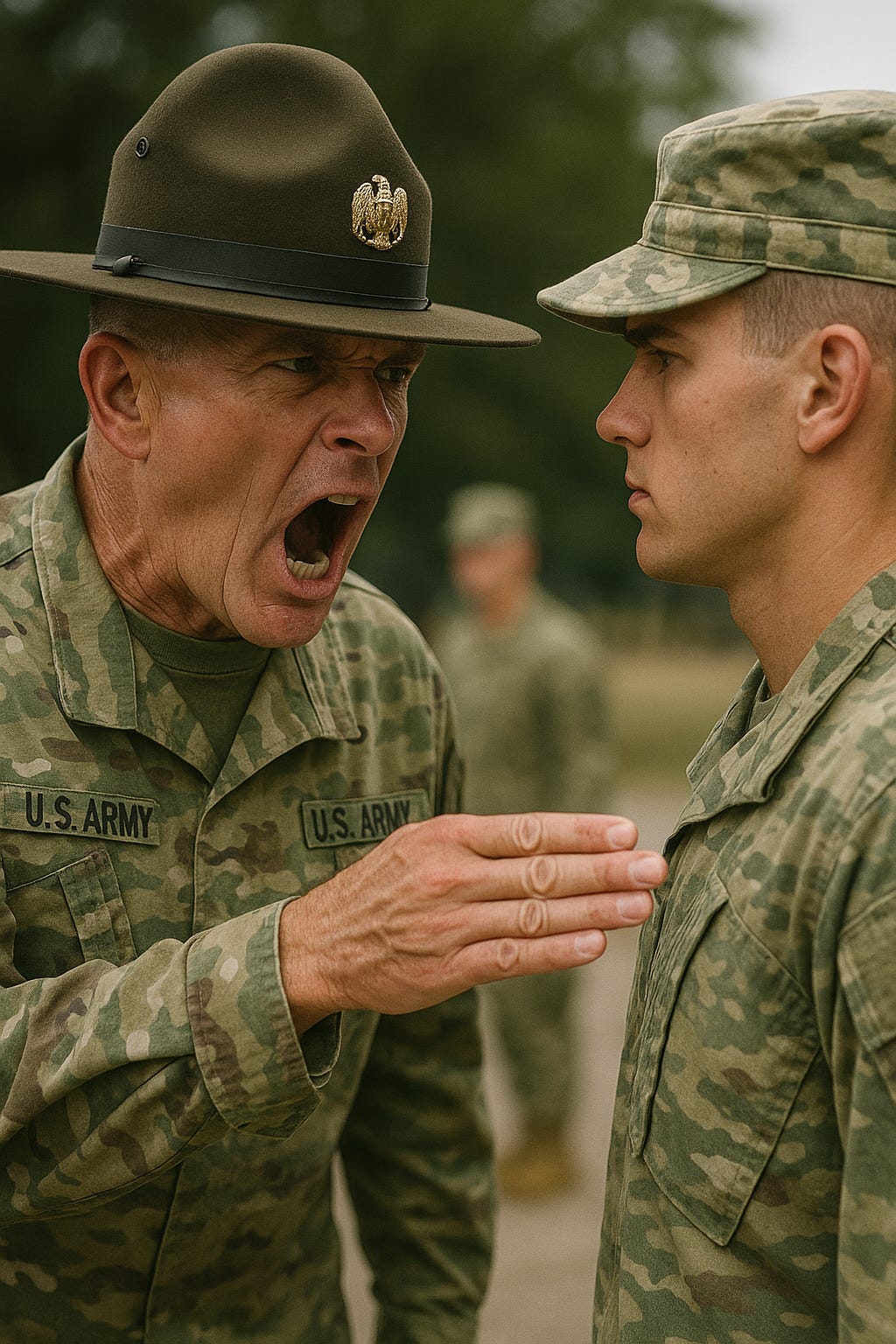
Above is a picture of a drill sergeant introducing a young trainee to this gesture. This knife-hand is not limited to one branch of service but the use of this gesture extends across all branches of service. Loud verbal communication usually accompanies this gesture which helps to make it that much more effective, but it is not always necessary because once a trainee becomes accustomed to this gesture, they know that it means they are about to face some corrective action of some sort. The knife hand is not only used for discipline. It can be used during a briefing to help emphasize a point, give directions when seeking cover during a firefight, or give direction down range as to where to focus the firepower of the most powerful fighting machine in the world. There is no more iconic gesture or form of non-verbal communication than the knife-hand. So why is the knife hand more effective than simply using a single finger or even two? One single finger is still just as easy to see and even can be intimidating when placed right next to your nostrils, but what better way to give more emphasis than having all five digits of your hand pointing at the problem you are trying to correct or the direction you are supposed to go. It is much harder to see one finger pointing
which way to direct fire through the mortar smoke, so using all your fingers helps to give a much clearer direction and get your point across.
II. Origin of the Knife-hand
The origin of the knife hand is a thing of legends, a mystery to say for sure. There are several hypotheses as to where it was originally started. It was thought to have originated by the French who referred to it as the doigt de guerre. Because of the black powder used in muskets back then, it made it hard to see so it was later revamped by Brig. Gen. Silas Casey. He went on to describe how a proper doigt de geurre should be used in their military regulations. “The hand, dexter, shall be formed as of a plane, inclined so the distal side of the hand is perpendicular to the ground. The hand shall be raised smartly to an angle of 45 degrees and, through rapid vigorous motion, be brought down in a series of strokes viz a trebuchet.” (Angry Staff Officer, 2017) Lt. General Ulysses S. Grant was well known for his use of this gesture when communicating orders. He can be seen in this picture below with his knife hand, holstered and ready to use.

There is also some belief it was a Prussian tradition. There seems to be no clear-cut answer as to who and where it originally came from but there is no denying the power that exudes from the fingertips of the one who utilizes the knife hand.
Conclusion
With there being so many ways to communicate, our verbal communication is so powerful, even more so than the words we use. The knife hand is a powerful gesture that can be used to help get a point across but this is only one small example of the types of non-verbal communication that we use every single day. Pay attention to those around you and see if the way they stand, what they do with their hands when talking or listening, or their posture, in general, does not speak volumes louder than what is coming out of your mouth.
References:
Angry Staff Officer. (2017, June 26). The history of the military knife hand. Angry Staff Officer. https://angrystaffofficer.com/2017/06/26/the-history-of-the-military-knife-hand/
World of Work. (2019, July). Mehrabian’s 7-38-55 communication model. World of Work. https://worldofwork.io/2019/07/mehrabians-7-38-55-communication-model/
Media References:
Angry Staff Officer. (2017, June 26). The history of the military knife hand. Angry Staff Officer. https://angrystaffofficer.com/2017/06/26/the-history-of-the-military-knife-hand/
We Are The Mighty. (n.d.). 8 photos of terrifying knife hands in action. We Are The Mighty. https://www.wearethemighty.com/articles/8-photos-of-terrifying-knife-hands-in-action/
Comments
Post a Comment